What is Tajweed?
Tajweed means "to improve" or "to do well". In Quran recitation it is the set of rules for pronouncing every letter from its correct point of articulation, with its correct qualities, and applying the rules that change sounds when letters meet. Scholars agree that reciting the Quran with enough Tajweed to avoid changing letters and meanings is necessary for every reader.
1. Noon Sakin and Tanween
A Noon Sakin is a ن with sukoon (نْ). Tanween is the double vowel (ـً ـٍ ـٌ), which sounds like a Noon Sakin. What happens to this "n" sound depends on the letter that follows it:
| Rule | Letters after | What to do | Example |
|---|---|---|---|
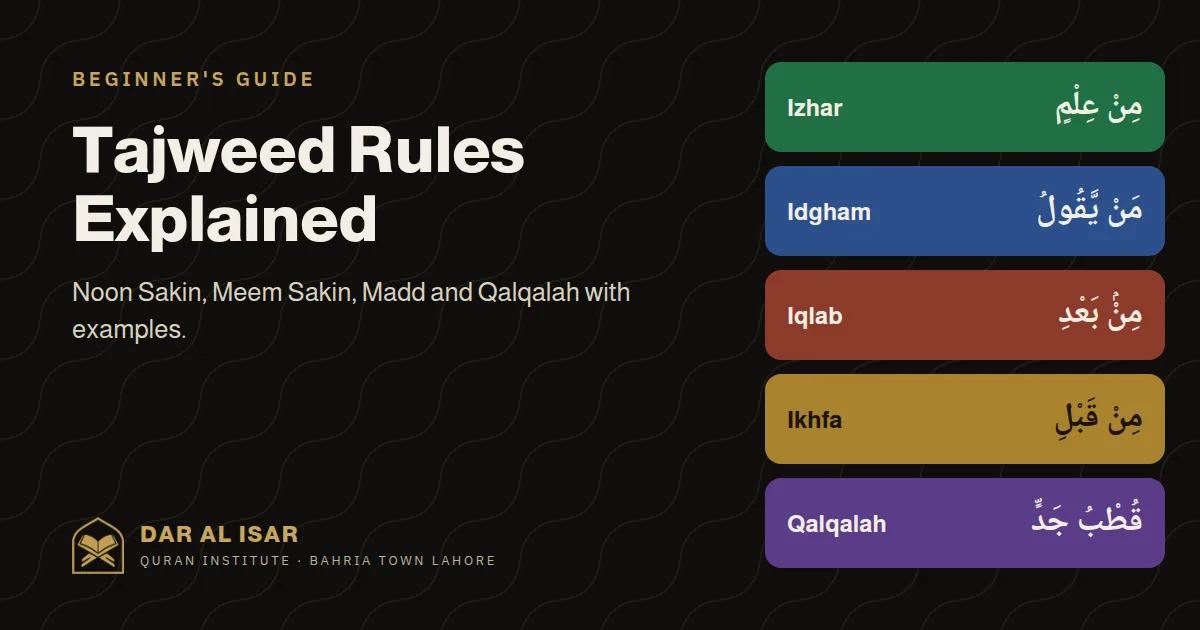
| Izhar (clear) | ء ه ع ح غ خ | Pronounce the "n" clearly, no ghunnah | مِنْ عِلْمٍ |
| Idgham (merging) | ي ر م ل و ن | Merge the "n" into the next letter. With ghunnah for ي ن م و, without for ل ر | مَنْ يَّقُولُ |
| Iqlab (changing) | ب | Change the "n" into a hidden "m" with ghunnah | مِنْۢ بَعْدِ |
| Ikhfa (hiding) | The remaining 15 letters | Hide the "n" in the nose with ghunnah, between Izhar and Idgham | مِنْ قَبْلِ |
A memory aid many teachers use for Idgham letters is the word يَرْمَلُوْنَ.
2. Meem Sakin
- Ikhfa Shafawi: Meem Sakin before ب. Hide the meem with ghunnah, lips lightly closed. تَرْمِيهِمْ بِحِجَارَةٍ
- Idgham Shafawi: Meem Sakin before another م. Merge with ghunnah. لَهُمْ مَّا
- Izhar Shafawi: Meem Sakin before any other letter. Pronounce it clearly. اَلْحَمْدُ
3. Ghunnah
Ghunnah is the nasal sound from the nose. It is held for about two counts on every Noon or Meem with Shaddah: إِنَّ, ثُمَّ.
4. Qalqalah (the echo)
Five letters bounce slightly when they carry a sukoon: ق ط ب ج د, remembered as قُطْبُ جَدٍّ. The bounce is stronger when you stop on the letter at the end of an ayah, as in اَلْفَلَقْ.
5. Madd (lengthening)
- Madd Tabee'i (natural): a madd letter with no hamza or sukoon after it. Held for 2 counts. قَالَ
- Madd Muttasil: madd letter followed by a hamza in the same word. Held for 4–5 counts. جَآءَ
- Madd Munfasil: madd letter at the end of a word, hamza at the start of the next. Commonly 4–5 counts in Hafs. إِنَّآ أَعْطَيْنٰكَ
- Madd Lazim: madd letter followed by a permanent sukoon or shaddah. Held for 6 counts. اَلضَّآلِّيْنَ
6. Heavy and light letters
Seven letters are always read heavy (with a full mouth): خ ص ض غ ط ق ظ, remembered as خُصَّ ضَغْطٍ قِظْ. The rest are generally light. Reading ص like س or ط like ت is one of the most common beginner mistakes.
7. Laam rules
- Laam Qamari: the ل of ال is pronounced. اَلْقَمَرُ
- Laam Shamsi: the ل is silent and the next letter is doubled. اَلشَّمْسُ
- Laam in the name of Allah: heavy after a fatha or damma (قَالَ اللّٰهُ), light after a kasra (بِسْمِ اللّٰهِ).
Quick Tajweed chart
| Rule | When | Sound |
|---|---|---|
| Izhar | نْ / tanween + throat letter | Clear "n" |
| Idgham | نْ / tanween + يرملون | Merged |
| Iqlab | نْ / tanween + ب | Hidden "m" |
| Ikhfa | نْ / tanween + other 15 | Hidden "n" |
| Ghunnah | نّ / مّ | Nasal, 2 counts |
| Qalqalah | ق ط ب ج د with sukoon | Light bounce |
| Madd Tabee'i | Madd letter alone | 2 counts |
| Madd Lazim | Madd + permanent sukoon/shaddah | 6 counts |
Frequently asked questions
Is learning Tajweed compulsory?
Reciting without changing letters or meanings is required of every reader. The detailed rules help you reach that, which is why learning Tajweed is strongly encouraged.
How long does it take to learn Tajweed?
Beginners can learn the main rules in a few months of regular classes. Applying them naturally takes ongoing practice with a teacher.
Can I learn Tajweed from a chart alone?
A chart helps you remember the rules, but you need a teacher to hear your recitation and correct it.