The sone ki dua is one of the most beautiful habits a parent can give a child. Every night the child lies down, and every morning the child wakes up — and Islam has given us exact words for both moments. The Prophet ﷺ taught us a short dua before sleeping and a short dua after waking, and he also taught us a simple bedtime routine: wudu, a clean bed, lying on the right side, and recitation for protection. In this post you will find the sone ki dua and the jagne ki dua with full Arabic, Urdu meanings, and hadith sources, plus easy tips to turn bedtime into a Sunnah routine your children will love.
The sone ki dua: before sleeping
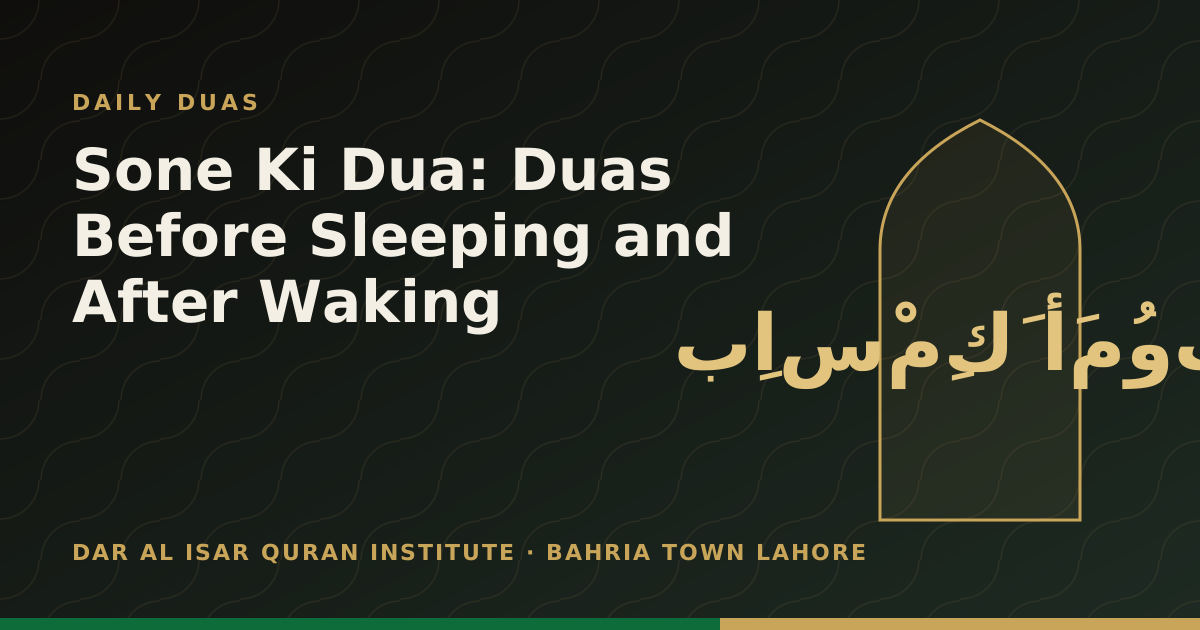
When the Prophet ﷺ went to bed at night, he would say the sone ki dua: "O Allah, in Your name I die and I live" (Sahih al-Bukhari 6324). Sleep is like a small death — we close our eyes and do not know if we will wake up — so we place ourselves in Allah's name and trust Him with our rest.
اللَّهُمَّ بِاسْمِكَ أَمُوتُ وَأَحْيَا
ترجمہ: اے اللہ! تیرے نام سے میں مرتا ہوں اور جیتا ہوں۔
O Allah, in Your name I die and I live.
Sahih al-Bukhari 6324 · said when going to sleep
These are very short words, and even a four-year-old can learn them in a few nights. Teach the child to say it after lying down, as the last words before falling asleep.
A bedtime routine from the Sunnah
The sone ki dua is the heart of the bedtime routine, but the Prophet ﷺ also taught us a few simple actions around it. Together they make a lovely routine for children.
1. Make wudu before bed. The Prophet ﷺ said: "When you go to your bed, perform wudu like the wudu for prayer" (Sahih al-Bukhari 6311). Going to sleep in wudu teaches children that cleanliness belongs to the whole day, not only to prayer time.
2. Dust off the bed. The Prophet ﷺ told us: "When one of you goes to his bed, let him shake off his bed with the inside of his lower garment, for he does not know what has come on it after him" (Sahih al-Bukhari 6320). Give the child a small job — shaking the pillow or the bedsheet — and they will enjoy being part of the routine.
3. Lie on the right side. The Prophet ﷺ would sleep on his right side (Sahih al-Bukhari 6311). Teaching a child to start sleep on the right side is an easy Sunnah they can keep for life.
Protection duas before sleep
After the sone ki dua, the Prophet ﷺ would recite for protection. Two of these are perfect for children.
Ayat al-Kursi (Quran 2:255). In the famous story narrated by Abu Hurairah (may Allah be pleased with him), the Prophet ﷺ confirmed that whoever recites Ayat al-Kursi at night will be protected by Allah, and no devil will come near him until morning (Sahih al-Bukhari 2311). Children who have memorised it can recite it nightly; it also doubles as revision of an important verse.
The three Quls. The Prophet ﷺ, when he went to bed, would cup his hands together, blow into them, and recite Surah al-Ikhlas, Surah al-Falaq and Surah an-Nas, then wipe his hands over whatever of his body he could — his head, his face and the front of his body — doing that three times (Sahih al-Bukhari 5017). This is a routine children adore: they copy the hand movements, and it becomes a sweet memory of bedtime with a parent.
For older children, the last two verses of Surah al-Baqarah (2:285–286) are also a treasure. The Prophet ﷺ said: "Whoever recites the last two verses of Surah al-Baqarah at night, they will suffice him" (Sahih al-Bukhari 5009; Sahih Muslim 808).
The jagne ki dua: after waking up
In the morning we thank Allah for giving us another day. The Prophet ﷺ taught the jagne ki dua for this moment (Sahih al-Bukhari 6325):
الْحَمْدُ لِلَّهِ الَّذِي أَحْيَانَا بَعْدَ مَا أَمَاتَنَا وَإِلَيْهِ النُّشُورُ
ترجمہ: تمام تعریفیں اللہ کے لیے ہیں جس نے ہمیں موت کے بعد زندگی دی، اور اسی کی طرف لوٹنا ہے۔
All praise is for Allah who gave us life after He caused us to die, and to Him is the resurrection.
Sahih al-Bukhari 6325 · said on waking up
This dua completes the pair: we went to sleep in Allah's name with the sone ki dua, and we wake up thanking Him with the jagne ki dua. It gently teaches a child the Islamic understanding of life — every morning is a gift, and one day we will all return to Allah.
Teaching the sone ki dua to children
- Do it together. Lie beside them the first few nights, recite the sone ki dua slowly, and let them repeat each phrase after you.
- Make the actions fun. The wudu, the pillow shake, the right-side sleep, and the hand-wipe of the three Quls give the child things to do, not only words to say.
- One step at a time. Start with the sone ki dua alone for a week. Then add the jagne ki dua in the morning. Then add Ayat al-Kursi and the three Quls.
- Keep a bedtime chart. A star on a wall chart for every night they say the duas without being reminded. Small children respond wonderfully to this.
- Never skip it. Even when you are tired or travelling, the routine stays. Children learn that duas are not optional extras — they are part of the day.
- Explain simply. Tell them: when we sleep we are weak and need Allah's protection, and when we wake up we thank Him for a new day.
For more short duas your child can learn, see our 12 masnoon duain for kids with Urdu meanings.
New students at Dar Al Isar Quran Institute begin with a 3-day free trial. Message us on WhatsApp at 0303 7347447 to book a trial class.
Frequently asked questions
What is the sone ki dua before sleeping?
The sone ki dua is Allahumma bismika amootu wa ahya — O Allah, in Your name I die and I live (Sahih al-Bukhari 6324). It is the dua the Prophet ﷺ taught us to say when going to sleep.
What should children recite before sleep for protection?
Ayat al-Kursi once, and the three Quls (Surah al-Ikhlas, al-Falaq and an-Nas) blown into the hands and wiped over the body, as the Prophet ﷺ did (Sahih al-Bukhari 2311 and 5017).
What is the dua after waking up?
Alhamdu lillahil ladhi ahyana ba'da ma amatana wa ilaihin nushur — All praise is for Allah who gave us life after He caused us to die, and to Him is the resurrection (Sahih al-Bukhari 6325).